In the workshop · Updated guide
Which work light should you choose for DIY and the workshop?
Portable lamp, headlamp or floodlight: choose workshop lighting around the task. Mounting, shadows, charging and two-light placement explained.

The essentials, first
For a fixed task, choose a light you can position and aim while keeping both hands free. A portable work light stays on the workpiece, a headlamp follows your gaze and a floodlight covers a broader area. Each serves a different purpose.
Keep in mind
- Decide whether you need to light a detail, a moving task or an area.
- Position and stability matter alongside stated brightness.
- Two lamps provide different angles; they do not guarantee shadow-free lighting.
In this guide
1. Portable lamp, headlamp or floodlight?
Imagine assembling a shelf on a bench. You need to see a marking without holding a phone. A portable lamp placed nearby can keep light on the workpiece when you turn your head.
A headlamp suits tasks where you move between positions. A floodlight is intended for a wider area. None of these automatically replaces the room’s general lighting.
| Your task | Format to consider | What to check |
|---|---|---|
| A detail on the bench | Adjustable work light | Stable support and useful angle |
| Moving between tasks | Headlamp | Fit and controls |
| A broad work area | Floodlight | Coverage and installation |
2. Adjust position before adding light
For a shiny workpiece, move the lamp a little and change its angle. Look from your actual working position with your hands where they will be. A light directly behind you may be blocked by your body or tool.
INRS recommends matching lighting to the task to provide adequate illumination and limit visual discomfort. These principles do not validate any Dealeez product.
Try a light from one side, inspect the marking, then try the other side. Keep the arrangement that lets you see the detail throughout the movement. Avoid looking into the source or aiming it at another person.
3. Check the support, not just the magnet
A magnetic base needs a compatible surface. Wood, plastic and aluminium are not magnetic mounting surfaces. Check the hold on the actual support with the head angled as you intend to use it.
Keep the lamp clear of tool movements and moving parts. If it is unstable, reposition it. Electrical work and professional sites require their own procedures and equipment; a task light is not protective equipment.
- Clean, stable support compatible with the mounting method.
- Light aimed at the workpiece without obstructing the movement.
- Lamp and any cable clear of paths and moving parts.
4. What can two lights do?
One lamp can illuminate a marking while the second lights the opposite face. Switch them on separately to see what each contributes. If the second causes glare, change its angle or turn it off: more sources do not always improve visibility.
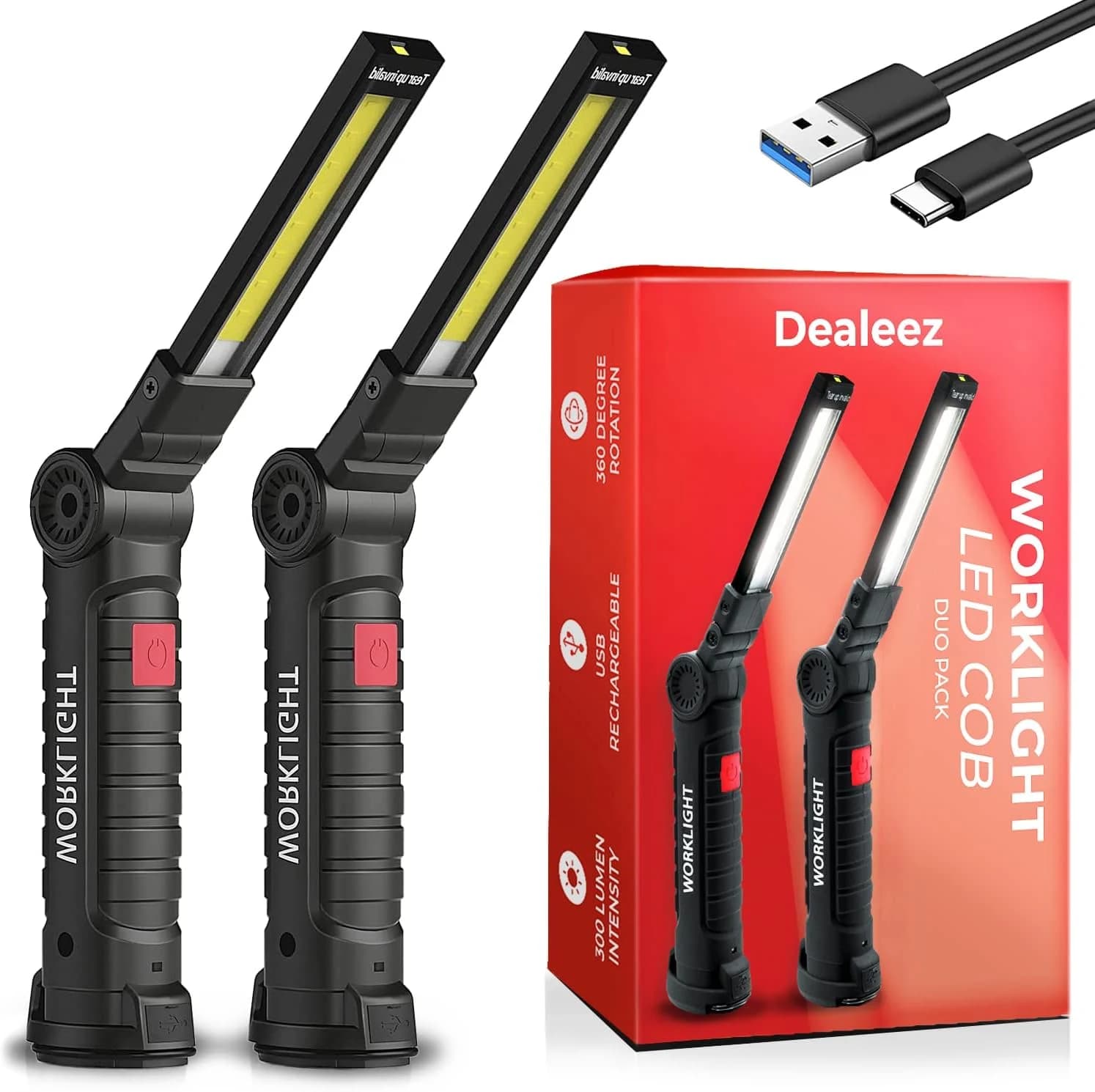
Alternatively, leave one lamp at the bench and take the other to a separate task. The Dealeez work-light pair offers magnetic bases, adjustable heads and USB charging for such arrangements. These are task lights; having two does not establish adequate lighting for an entire workshop.
5. Check your space before buying
Consider available space, the support material and access to charging, then compare documented technical details. A workshop image cannot establish runtime, water resistance or professional certification.
Charge and check the lamp according to its manual before a long task. If a runtime or protection rating is essential but missing from the product page, ask before choosing.
- Can the lamp stay where the light is needed?
- Can you aim it without moving the whole assembly?
- Do you have a compatible cable and power source?
- Do documented usage limits fit your task?
Your questions, answered.
Can one portable lamp light an entire garage?
Not necessarily. A portable task light serves a specific area. Assess general lighting, access routes and the work position separately.
Will a magnetic base stick to any metal?
No. Not all metals are ferromagnetic; aluminium is one example. Check the hold on your actual surface before working.
Can a headlamp replace a work light?
It can help when you move frequently, but its beam follows your head. A portable work light can keep the light on one piece. Choose according to the task and available space.
Sources and references
- INRS — Éclairage artificiel au poste de travail, ED 161Accessed October 1, 2026
Published · Updated
Explore the collection
Two lights to position around your project
Explore the work-light pair and its mounting details, then compare them with your bench requirements.
Find my manual